Sunday, January 7, 2018

Y Code Parts Dept: 1972 LeMans & GTO grille inserts

                                                                          By: Patrick Smith
       
   Since 1972 was an extended production year with a carry over body, Pontiac had to come up with a few visual changes to make the 1972 LeMans and GTO stand out from last season's stock. The extra wrinkle is they had to do it on a budget because the budget was small. No one wants to spend big outlays on an outgoing model. It's not prudent and the chances of making any returns on the tooling are nonexistent. One change Pontiac did make was to the grill. They made new deep white metal grill surrounds (called bezels) but kept the basic shape of the grills. Instead of bright checkerboard plated grilles mounted up front, the 1972 grill inserts were recessed deep behind the metal bezels which were painted argent and held in place with speed nuts.
 
This grille GTO emblem is a one year piece as well. Part # 546501. It was no longer available from GM by 1983.
  A little die cast GTO logo went on top of the driver side grille insert, also held in place via speed nuts. These grille inserts were made of aluminum and somewhat fragile in nature. A bird strike can easily damage the egg crate pattern and permanently distort it. Given part number # 486397, the part number applies to a single piece and since it is reversible, there is no LH or RH part number. You merely ordered two of the same part number, plus the GTO call out if yours was missing or the "Arrowhead and LeMans" call out if your car was a LeMans with the T-41 option. The grill inserts have been out of stock at GM since 1983 according to the parts catalog issued that year.
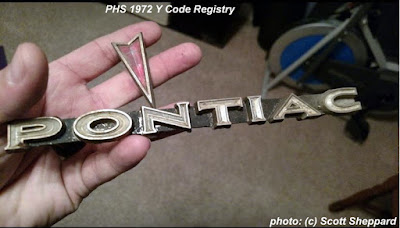
 
The 1972 Pontiac Endura grill nameplate is the same piece used in 1971 cars and uses the 484606 replacement parts number.
  T-41 option was a $41 extra feature which could be ordered for your LeMans Sport to dress up the car and make it look like a GTO. It was quite popular and a lot of cars had this. The part number for the 1972 GTO grille call out is pn 546501. They are available in original and reproductions. The part number for the "PONTIAC" callout is pn 477741 7002(c)2. It is the same piece used in 1972 Endura grill cars and shares the replacement number 484606. The 1970 "PONTIAC" grill nameplate is a different piece.
The arrowhead is a separate casting held by two lugs and speed nuts and is pn 478649 13342. 
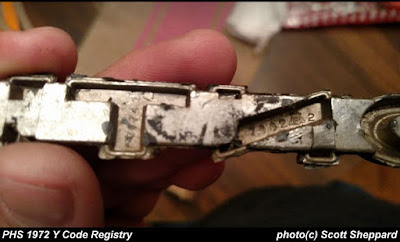

The LeMans T41 PONTIAC script and arrowhead were cast separately for easier handling
of the part. Both items were held in place with nuts.
                         
Here, the part number can be seen on the arrowhead underside.
   It may surprise you to learn they weren't one piece but making such a big casting in one piece with three dimensional clarity would have cost more than doing 2 separate pieces. Since GTO sales were falling fast, cost cutting was needed to keep profits rolling in. That meant a cheaper method of casting parts where possible. They basically re used the 1971 PONTIAC nameplate and although the 1970 version looks the same it bears a different part number. The same goes for the 1969 vesion.
 

Flimsy "butcher paper" wrapping was all that protected the grills during shipping. Shelf wear of corners
was a problem as well.
   The NOS grilles themselves are somewhat scarce being a one year only part and shipped in rather flimsy "butcher style" brown paper with turquoise GM logos and ink stamped part numbers. The corners are often dented and shelf wear is definitely a problem in some cases. Fortunately there is a reproduction alternative available. The Parts Place in Chicago is selling these pieces again. I have ordered a set in for the project Y Code GTO and will be doing a product review and comparo to the original pair from my car.  National Parts Depot catalog shows a part number for 1972 grill inserts but beware. The part number is identical  to the reproduction 1971 barbecue style grill inserts. A photo shows you the piece isn't at all like the 1972 item. This is why I ordered it from Parts Place.

Parts are made of fairly soft aluminum and are held by speed nuts onto grill surrounds. 
   While we're at, let me address the issue of grill color. All the 1972 cars got gray grilles, whether they were 455 HO, striped cars, plain jane or loaded. No blacked out grills existed for the 1972 LeMans or GTO. Blackout grilles are listed for the 1971 GTO Judge and they have their own part number. The Judge was dropped in winter of '71 and didn't return. Gray is the correct color. It is very common to see them painted black which is fine if you want to customize the look of your car. It isn't concours correct however.

Availability and Pricing: The grill inserts are reproduced and so is the GTO 1972 only call out. Original GTO call outs are also available as they often show up on evilbay and local CL listings. The GTO call out and 1972 grills have been discontinued since 1983 so it's nice to have new ones offered. The arrowhead and PONTIAC call out for the LeMans cars with T-41 also show up and in theory should be easier to find than the GTO call out. Somehow that isn't holding true in real life. I suspect the reason is due to it being a 2 piece affair. More prone to rattling off from road vibrations and bird strikes. By the way, the parts manual suggests gluing the emblem in place with Dow Corning epoxy. Pricing isn't a big deal for these parts. NOS grille inserts are being offered in original wrapping for mid $400 a set, but I don't see anyone snapping them up at that price.

Yes, that's how they look out of wraps.Those little irregular tangs at the top and sides distinguish them from
the regular LeMans non T-41 grille inserts which aren't big enough to fill the white metal grille surrounds on a T-41 car.
  The call outs are inexpensive, GTO averaging mid forty dollar range for a nice condition piece. The arrowhead is offered as a reproduction and some NOS stuff is available as well. Just price shop until you find a deal you can live with.
 
1972 Grill bezels aren't reproduced yet and are difficult to find in show condition.
The argent silver paint is available and very light pitting can be sanded and painted over. Broken
studs, cracks and pitted brightwork affects value considerably. Excellent pieces can be $220 each or more.

  The grill surrounds for 1972, (called bezels in the GM parts book) are harder to find. The LH part was out of stock by 1983 and the RH piece was in the same situation later that decade. Neither part is being reproduced at present. They are;  LH486394, RH 487747. When they come on the market they range from $150 to $220 each depending on condition. The usual issues are broken speed nut studs and pitting of the white metal inside the surrounds and argent paint loss. The chromed external surface is prone to pitting as well and affects value. Paint loss is repairable with correct paint and minor pits can be removed.
  * Article (c) 2018 by Pat Smith for PHS 1972 Y Code Registry, special thanks to Scott Sheppard and Craig Eckhart for assistance.

Tuesday, January 2, 2018

Tail Lamp Lenses: What was correct for 1972.

                                                                         By: Patrick Smith

  One of the hang ups of restoring a 1972 Pontiac GTO is it was a "build out" model year. What that means is it's the last production year of an old body style before the plant is shut down for retooling for a new body style. In practical terms, it means some parts are going to be in short supply and if a car is being assembled needing those parts to complete the job, a couple of things may happen. The best case scenario is if the assembly line gurus in charge of production logistics are doing their job and spot that supplies of certain parts are too low to assure the quantity of cars being built will have the necessary goodies, the job order gets delayed. In effect the data processors for production orders would  hold off or "block" the order and enter it when adequate supplies of parts were in storage to do a build of cars. In the ideal world that's how it's supposed to happen.

The LeMans, LeMans Sport and GTO got smooth tail lamps for 1972. In the real world, a few GTOs, LeMans and
even LeMans Sports got some ribbed lenses. It's unknown whether it was due to carelessness or supplies running out
as cars in early and late production have been observed with incorrect lenses.

The 1972 Luxury LeMans got ribbed tail lamps from 1971 which were "First Job"
GTO lamps according to the 1974 parts catalogs. After Job lamps were smooth and minus silver paint. 
  In reality, a couple of problems made it difficult to guarantee a steady supply of all the goodies to all the plants. One problem was a GTO required a lot of extra parts not used on the LeMans body. The front end is completely different, including the hood, fenders, bumper, grilles and rad header panel. The front end was also available as a option on the LeMans Sport as the T-41 front end. It was quite popular that year as it was promoted in special 2 page color ads. GTOs also had a few special bits here and there like engine turned metal lower dashboard trim, decals, a minimum engine displacement of 400 cubic inches with four barrel carb and either a manual three speed on the floor or automatic column shift TH400. These and other details meant  more logistics planning for data processors and build sheet orders. The last hang up was a dramatic fall in demand for GTOs that season. Production dropped from 10,532 to about 5,673 cars that year.

   Considering how many different parts had to be thrown together to make a GTO instead of a LeMans it made sense for the data processors to bank a bunch of GTO orders and build them together in "batches" to prevent jamming up the line. After the initial season kick off of orders started filling the pipeline they waited for dealer orders...and waited....and waited. They got T-41 LeMans Sports orders but few GTOs. A decision was made early on to batch build the GTOs by storing up orders until enough could be run off to make it worthwhile. Sales were poor enough that the batch build order was amended to include LeMans T-41 cars as well since they used the same front end as a GTO.
 
A survivor Y Code in Georgia shows the "After Job" lenses did get silver paint, contrary
to what the parts book stated in 1974.
   Since it was the last year for this body style, re orders for parts were done  early. Whatever wasn't used near the end of production was used for parts inventory.When you're getting product out the door on the clock, you're not going to fool around searching for the correct tail lamp to complete your build. Jamming up the line was bad and God forbid if you shut down a line because you didn't have smooth tail lamp lenses for the GTO in your pit! No way, if you didn't have smoothies but a bunch of ribbed tail lamps were sitting handy, that's what went on the car. Technically it's wrong, but it happened. Presently our registry has  many entries and only two had ribbed tail lamp lenses, one was an early build convertible, the other a hardtop assembled in the last week of May. It's possible that one  was a build out car.

The 1970 only version included chrome bezel trim. Part number is different as well on box.

The part number for a 1970 GTO tail lamp RH assembly.These are reproduced now.
Part Numbers & Styles:
  Next thing we need to do is look at what was available for lenses in 1972 and what was used on the line. The 1970 GTO-Tempest lens were marked 5962274 RH and 5962273 LH. These were superceded by #5964078RH and #5964077LH.
For 1971 the parts book shows a new design described as "First Job w/3 exposed vertical ribs and silver paint along periphery" The part numbers for First Job 1971 lenses are: #5964570 RH and #5964569 RH. Below this is a listing for 1971 lenses described as "After Jobs-Less 3 exposed vertical ribs and less silver paint on periphery." The part number for "After Jobs" lenses are different from First Job lenses as well. They are: #5964078RH and 59647077 LH. There is no specific 1972 lens part number for the LeMans or GTO. They used the "After Job" assemblies listed under 1971 in the parts book. Also it should be noted the description of "less silver paint" is wrong as well. Survivor GTOs and LeMans clearly show silver paint on the edges. 
     
The box for 1971 tail lamps with part number. These babies in good condition sell for a lot of money. Reproductions
are available now from The Parts Place.
A pair of  New Old Stock "First Job" 1971 tail lamps. Note the silver painted accents and vertical ribs. Some have been
used on 1972 GTOs. Only the Luxury LeMans cars were supposed to get them that year.
Applications:
  As for applications, the ribbed vertical lenses were used on 1971 GTOs and for 1972 they were used on the Luxury LeMans as a dress up item. The 1972 GTO and LeMans models were supposed to use smoothie lenses which would be "After Jobs" pn 5964078 and 5964077. In theory that's how it was supposed to go. In practice this wasn't the case. Since both styles of lenses were available at the plant from roll out of production, it appears any GTO or LeMans that got the ribbed lenses were just assembly line errors and not true "build out" cars which would be the case from half way through the production year when supplies did run low. Another problem is the confusing terminology of "FirstJob" and "After Job". This relates to the 1971 redesign and the major strike that happened at GM, delaying roll out of 1973 models by a whole year. Since Pontiac needed to make the GTO last one more season, they contracted a cheaper lens design without ribs and chrome trim. It became a footnote in the 1974 Parts Book. There are other instances where the 1972 is merely considered an extension of the 1971 model year.


   We do have a few instances of 1972 cars with ribbed lenses but with so much time lapsing from production to the present, it's only prudent to consider survivor cars or ones with a solid documented history establishing these parts were present when new.We will update the article when we get solid evidence of deviations on early production 1972 GTOs.

   The NOS ribbed babies aren't cheap. They're selling for almost two grand once you include shipping. Luckily they're reproduced now.1971 GTOs used them as standard  issue so a few top drawer restorers will pull the trigger on these survivors if the car warrants it.The smooth 1971 and later lenses have no chrome bezel either. They got silver paint instead.Those are correct for 1972 GTOs and LeMans. The station wagons had their own lenses and housings. The numbers are included in the chart below for reference, just in case you're restoring a Y Code wagon. I wanna hear from you if you are!


Chart showing housings, lenses part numbers and notes for same. This is a 1974 parts book.

  I have included a chart to show you the application numbers and notes issued on tail lamps, housings for the 1970-72 era GTO and LeMans cars for reference purposes.

The Takeaway:
Pontiac used three styles of tail lamp lenses on their 1972 LeMans cars, a smooth tail lamp, a vertical ribs lamp and a separate completely different station wagon lens.

The vertical ribbed lenses were only supposed to be used on the Luxury LeMans cars for 1972. They were first used on 1971 GTO cars. "After Job" lenses were smooth and listed for 1971 GTOs and Tempest cars in the 1974 parts catalog. This, along with the "less silver paint" description are errors and should have been listed as 1972 because they were contracted for that model year.

Some 1972 GTOs and LeMans did get vertical ribbed lenses. Some got them early in the year like one convertible in our registry, others like mine got them late in the year. It could be a "build out" supply problem or an assembly mistake. Technically, ribbed lenses on a 1972 LeMans or GTO are mistakes. A few cars got them however so if you have documentation to prove it was original, by all means keep them.
        *Article (c) 2017 by  Patrick Smith for PHS 1972 Y Code Registry


Friday, December 29, 2017

Lost: 1972 Y Code Revere Silver GTO hardtop

                                                                     By: Patrick Smith

   This is a different post for certain. Instead of listing a new entrant in the Y Code Registry, we're describing a car long ago cast away by a previous owner. This was in the past when he wasn't aware just what he had. Looking back, he wishes it had been a different outcome! Our story begins with a nice looking 1972 GTO hardtop finished in Revere Silver metallic and a lush black Expanded Morrokide interior. The drive train was a 455 four barrel L75 motor which was code "Y" on the VIN and backed with the TH400 automatic transmission and 12 bolt carrier. All 455 powered A body Pontiac cars had the 12 bolt carrier that year.

A bit grainy, but it's all we have of Bill Wolfe's Y Code GTO. 
   For options this car had Am Fm stereo radio with 8 track player, Rally II wheels on 15 inch rims with the TXL wheels 15 inch Goodyear Polyglas G60 x 15 raised white letter tires, rocker panel trim, wheel well moldings, console, Safe T Track limited slip differential, Formula steering wheel, tinted glass, custom interior group which gave you upgraded door panels with pull straps and carpeted runners and of course, Expanded Morrokide seat coverings in bucket seat style. finally the car had chrome fixed pedestal rear view mirrors and Y98 suspension option. The owner was Bill Wolfe at the time and the picture you see was when he owned it.

  This is the second Revere Silver Y Code in our registry. Revere Silver is one of Pontiac's nicer colors that year. You could get a number of interiors to go with it but to me, black is the best choice. Available that year was a Pewter vinyl interior which is quite difficult to get colors to look right when dying it. As for Revere Silver paint, we have another one located in North Dakota which was for sale. Sure would be ironic if it was the same car, wouldn't it? A quick look at the options scratches that theory. Our North Dakota car had a vinyl top and base steering wheel with power windows. I guess Mr. Wolfe will have to keep searching for his old ride. I hope he finds it.
  * Article (c) 2017 Patrick Smith PHS 1972 Y Code Registry

Monday, December 25, 2017

The Rear Spoiler--The "Option" that never was!

                                                                      By: Patrick Smith

  This is sort of an awkward subject. I liken it to saying "the bull jumped over the fence" when talking about someone's kid in front of their parents in mixed company. I will dispense with the unpleasantness now and move on to the actual topic at hand; rear spoilers for 1972 GTO and Lemans. You see, Pontiac didn't offer a rear spoiler on their 1972 GTO  as such. There was a duck tail spoiler, new for 1972 shown in print but the mold for the three piece unit broke the first week in production and it was never repaired. Some say the mold broke the first day. All I can tell you for sure is two LeMans cars got them from the factory and one GTO had it added using a parts counter purchase. Those are the only known cars to have ducktail spoilers. John Sqwirblies' Sundance Orange 1972 GTO hardtop is the single GTO and the LeMans cars were early production press pool cars used for road tests in Super Stock magazine. There was a 1971 spoiler standalone option listed as UPC N90 option in group 474. That was how you could get a spoiler on a non Judge car in 1971 only. By 1972 the spoiler option was gone.
 
John Skwirblies 1972 GTO as it appeared in Muscle Car Review's Factory Freaks issue. Title is a misnomer
in Skwirblies' case as the spoiler was an over the counter purchase post sale.Note the 1971 tail lamps.
   Meanwhile it was available over the counter and installed by many an owner at the dealer or by themselves, the 1972 GTO and LeMans Sport were sold spoiler free. So many have worn them over time one can be forgiven for thinking it was available that year. Reproductions are available now of every GTO spoiler from 1969 to 1972. The last one, the duck tail, was repopped using the example from John Skwirblies' car which had one installed from an over the counter purchase back in the day. We'll show you his Sundance Orange hardtop and pics of that set up for reference purposes.


The underside of Skwirblies' 1972 ducktail corner spoiler. It is somewhat rough and not up
to the usual quality of a GM part. 
    Actually Skwirblies car is interesting for a couple of reasons. It sports a bright rear view mirror assembly which has long been believed to appear on early production 1972 GTOs before the Federal Mandated black pebble finish mirror was enforced as a safety feature. Bright mirror backs were believed to cause blinding reflections on sunny days. His GTO also has 1971 GTO tail lamps which was commonly found on build out year GTOS and LeMans. Officially, the Luxury LeMans cars were supposed to be the only ones using these that year but many GTOs and LeMans have shown up wearing a set.

    My car, a last batch build example had a set. It's interesting  to see Skwirblies car had  a pair as well. Since his was restored in the mid 1980s before much was known about the 1972 cars its likely incorrect parts were installed as well. We know Ram Air induction wasn't offered with the 400 yet his car had this set up in the photo feature taken in the Muscle Car Review article for their factory freaks article. Skwirblies car also has a set of early 1972 custom interior door panels with pull straps, carpet runner and 1971 GTO emblems above the arm rests. Early build 1972 GTOs are known to have this feature and it disappeared later on. As for the rear spoiler, we have a detail image of the underside of the end corner piece. As you can see, this was a somewhat shoddily manufactured set and you can see why it would break easily. Engineering probably deemed it wise to eliminate the tooling when the dies broke.
Box containing an original 1970 GTO spoiler. Good units are $1000 apiece now but
reproductions have been available for awhile now.

  For 1970, the rear spoiler was revised completely and issued a new part number along with accessory kit. This spoiler, pn 480473 and accessory package pn 988806 were for the convertible and hardtop car. There was a 1970 convertible accessory package issued as a part number, 988833 but it is unknown if it actually made production. By the way, there is no such thing as a Judge torsion bar trunk rod. The manufacturer simply changed the position of torsion bars to add extra tension. The 1971 GTO spoiler isn't the same piece as the 1970 unit. There are minor differences between them. Basically the variations are; wide set mount, rough bottom seams on spoiler underside and smooth seams on underside.
 
Original pieces were rough underneath. The pedestal mounts were studs as well.
  When it comes to reproductions some vendors have replicated the rough seams found on the underside of spoilers. A repop also exists with the smooth underside as well.They differ by weight compared to the originals however and the pedestal mounts are studs on originals while threaded bolts are on reproduction pieces. The mold quality underneath was abysmal compared to today. This kind of sloppiness was acceptable in 1970 from an outsourced supplier to the Big Three. The revised spoiler was eventually smoother underneath but the early "3 piece" versions looked like the black one you see above. That's how it was. They are heavy pieces too. The lightweight units being reproduced now are like balsawood in comparison! By the way, the holes for studs are 4.75" apart from center to center.
 
Even when painted you can see partial separation between pedestal mount and the
actual wing underneath this 3 piece spoiler. That's how it was. Things weren't perfect back then.
   I haven't any pics of accessory kits yet to show you. Likely are the attaching hardware for the studs. Have a look at this painted spoiler underneath and you'll see what it was like to have one of these babies installed and why some cars are deemed over restored nowadays. Cars didn't come out free of paint runs, orange peel and zero roughness. An exhibition car might be like that but not a regular ordered car. Something to think about when you're trying to nail that showroom new look.
                *Article (c) 2017 PHS Y LeMans and GTO  Y Code Registry. 


Another Y Code LeMans Sport Convertible Found

                                                                          By: Patrick Smith
           

As you can see, a GTO grill badge was added by owner. An understandable sentiment since it is as
as you could get that year. Car is still in original owner's possession and in good shape!
    We recently rediscovered another Y Code convertible to add to the registry. I knew about this car 8 years ago when I'd bought mine and was doing research on the drive train and D98 stripe option which my documents stated it came with new but had nothing when I purchased it. I was considering ordering a set from Phoenix Graphix but wanted to know what the originals were like so I could compare them and see if they were close enough. Well, on a website that specializes in GTOs owned by , there was an Aztec Gold 1972 convertible with white lazer stripes, exactly what my Cardinal Red car would have. I emailed the owner and talked to him about the stripes. Turned out they were factory original. He was able to answer my question about whether the decals were sealed on top between each lazer cut out, preventing wax and moisture from getting in there and causing tears. GM did indeed do a laminate layer on top the lazer stripes. My question, answered, I thanked him and went on.
 
Another dusk view of the Aztec Gold Y Code convertible.
   I started the registry in the summer of 2015 and entered the ones I knew about off hand. Alas, I cannot find the Starlight Black hardtop that was in Peachland, BC. It had a later VIN than mine and may very well be the last 1972 455 GTO made.Maybe one day...I was on the web last week when I saw this car appear in one of many community pages dedicated to GTOs. It seemed familiar. I looked at the plates. Yes, this was the car I saw many years ago. I contacted the owner and learned that when I first made contact, the car was in his son's possession. The original owner is the father and he has the car back in his garage. It's always been and still is in good hands. In fact, the engine was rebuilt in 1995 and runs like a top. Speaking of tops, the car sports a white one from the factory. We should go over the list of goodies because this one's a real beaut!

The owner's car with his son's German Shepherd in the front. 
   Starting off with a November 18th 1971 build date at the Pontiac plant in Michigan, this convertible received Aztec Gold metallic paint, 272 White interior and code A White convertible top. It came through with the L75 250 horsepower 455 4 barrel V8 and TH400 transmission. The GM Canada documents show just 6 of the 307 convertible LeMans Sports sent to Canada had L75 engines. This is one of them. For options, the car received power windows, bucket seats, chrome front door edge moldings, wheel well moldings, heater and defroster,  sport mirrors, front console, white lazer stripes,standard rear axle ratio of 3.31, Safe T Track limited slip differential, custom pedal dress up, manual drum brakes, dual exhaust, power steering, rally II wheels, trim rings, G70x 14 white letter tires, Endura Styling option, AM push button radio, rear speaker, additional fuel for delivery and the mandatory Canadian Equipment option since it was sold new in Manitoba.
 
Notice in this pic you can see the location of the die cast 455 fender emblems as used on
LeMans Sport cars. This emblem was used for both 455 motors round port and D port but only only LeMans Sport
cars, not GTOs. For more info check out our 455 Die Cast emblem article on this site.
    The car is in good shape and still in the hands of the original owner. How about that for cool history?An early production car, it sports the 140 mph speedometer yet has the Federal mandated safety style rear view mirror finished in black pebble instead of bright metal as found last in 1971 GM cars.I've seen some 1972 cars with the older style mirror in place, but not many. In one GM promotional photo there is a Cardinal Red hardtop with the bright rear view mirror installed. Such deviations are known to exist as they are using pre production cars. Another example is the Aztec Gold 1972 GTO 455 hardtop used in promotional photos by GM. It would appear the Federal mandated mirror assembly was available early in production but perhaps not in sufficient quantity for every car to get one.
 *Article (c)2017 by PHS Y Code Registry. 
   

Tuesday, November 28, 2017

PHS Y Code Registry: Product Review Parts Place turn signal bezel

                                                           By: Patrick Smith

  Restoring the 1972 Pontiac LeMans or GTO can be a heart breaking experience. If your car needs a dog house for instance, those T 41 front end clips are frightfully rare and expensive. Owners looking for GTO hoods often have to make do with repairs to the front sections of their existing hood to remove the tin worm's presence. A good GTO hood is a $700 and up item....when one appears. The fenders are one year only pieces as well with those air extractors. Again these are noted for rust in the dog leg area. Patch panels are often the only way to go in light of non existing pieces. The 1972 was a build out year for the GM A body and low production makes like Pontiac's GTO model often are the last vehicles considered by reproduction companies to make parts for. Certain trim pieces such as the parking lamp bezels have been scarce for decades. Owners often just sand down the pit marks on their pieces and re spray them in silver.
  
A class 1972 LeMans T41 or GTO restoration includes new turn signal bezels. 

  Until now, that is. The Parts Place issued an eBay listing last winter for the 1972 GTO parking lens bezel. You can get the cat walk chrome trim to distinguish your car from the 1971 plain lens counterpart. It's an attractive, stylish piece, no doubt, influenced by the Camaro version from 1971. The Parts Place mentioned in their ad that this is a new, quality item NOT low pressure casting that was described as 'inferior.' Having no experience with aftermarket versions of this bezel, I cannot comment further on this. The price was right, at $29.00 a unit. I placed an order and waited.....and waited. A couple of days later I was informed it was on national back order. No where does the ad state this. I believe what was really happening is The Parts Place was collecting orders, waiting for a certain size of orders to appear, then they'd order a batch to be made by their contractor. Since these are low production cars with only 5,806 GTOs were made and a bunch more of the LeMans with the T41 front ends, The Parts Place likely has to do it this way to prevent having parts lying around taking up space and tying up money better used elsewhere. 

The original bezel from Miss Hot Stuff is on the left. The Parts Place bezel is on the right.

  The same situation occurred with Trans Am dash pads a few years ago. Some other company had eBay ads stating Trans Am dash pads were available. When you placed an order, you were contacted and told you were on a list and when enough orders came they'd tool up a run. Of course, some buyers weren't pleased with this development and cancelled. Naturally this program never got off the ground. Today very good dash caps are available at a good price. You can also send in your core to be rebuilt. Not cheap, but the only acceptable solution for a restoration. In this instance, my back order was placed on March 10, 2014. The Parts Place confirmed that my set was being made in April, 2014. Then I was contacted again to let me know they were shipping. The invoice shows a shipping date of April 29th 2014. One weird thing about the shipping, it was $68.00 American total including the parts which were listed at $58.00. The reason shipping is high is twofold. One:) they use first class postage Two:) It was an international ship from USA to Canada and of course, Customs gets their dirty paws on it. I was surprised to see they were sent in an air bubble bag which had been cut apart and taped together to make a little pocket for each bezel. It seemed to work this time out. Not sure I'd rely on that for longer distances. 


Here is the back view of the bezel. Note the part number cast right into piece like the
original.

  OK, let's talk about the bezels. First, they're die cast chromed pieces. Part number XL4155G. The plating is very good. No casting flash either. The actual die casting is smooth where you want it to be. Even the unexposed area lining the inside of the lens housing is good. High marks all around for this. How does it compare to the original GM part? You'd have a bit of trouble telling them apart if they were on the car. Once they're off you can spot one difference. On the inside the originals are duller plated than the Parts Place item. This could just be age but I believe it is also due to less plating on the originals. The other clue is a full part number after the MDC stamping on the cats eye rib. A GM original will have MDC, then 545588. Now the Parts Place items are stamped in the same place with same number, but a careful comparison reveals a sharper set of numbers. If they used original tooling, it was cleaned up. The result is a better looking piece. Installing them is identical to factory units. Two shouldered screws fit in through the lens and bottom out on the chrome chamfered seat on the bezel. Do not tighten hard on these. 


The original lens bezels get pitted and chrome peels away. Time for a change!


  Just make sure the bolt is flush or almost flush. The thread is doing the work on holding it in place. These aren't going anywhere. The army of bugs, flies sand and road dirt is going to lock that bezel in place within 100 miles. So after comparing the two items, I have to say The Parts Place knocked this one out of the ballpark. It's a great reproduction for a reasonable price and it fits just like original. You may have to wait to get your set but it'll be worthwhile.

 
You'll notice the parking-turn signal lens is a 1971 piece. Only addition for 1972 was this bezel.
   *Article (c) 2014 by Patrick Smith PHS Collectorcarworldblog. All product reviews were 
conducted with material purchased by owner. No promotional, samples or giveaways were used. You get an unbiased, accurate assessment of the product as a result.
    

Tuesday, October 17, 2017

1972 Pontiac GTO Y Code Revere Silver

                                                           By: Patrick Smith
 
You can see the body is more or less complete but in need of repairs. The driver side fender has been punched
and the quarter panel has rust and damage. Vinyl top looks decent. It appears to have either a Dixco or 1967 Pontiac
hood tach installed. Pontiac ceased factory hood tach installs in 1972.
We have  another new entry to the Y Code Registry on record. This is our first car finished in Revere Silver metallic, which is a nice color. From the state of Illinois, this Pontiac plant assembled hardtop came through with some nice options. I understand it is now in Horace, North Dakota and for sale.The first of course, is the L75 455 four barrel d port engine with mandatory TH400 automatic transmission. The 12 bolt rear end completes the drive line package out back. 
 
It certainly appears that someone is getting this car mobile again. A lot of extra wiring and a junction block is on the
firewall. I notice more stuff in the trunk area. Perhaps a car alarm system?

  For options it has variable ratio power steering, power disc brakes, console, black expanded Morrokide vinyl custom bucket seat interior which also gave you the deluxe door panels with pull straps and carpet runners. The car also has the GTO option,  air conditioning, vinyl roof , tinted glass windshield,  electric clock, power windows, AM FM stereo radio, rear speaker, honey comb wheels, heavy duty battery and front floor mats. It is actually a later build car according to the VIN number but it  has the second lowest VIN number in our database.

The engine is said to be numbers matching and intact. Some attempt at repairs has been done. Note the newer
power brake booster, blue anodized alternator and valve covers. Just so you know, Pontiac never used those horrible Buick inspired air cleaner decals. The D port 455 came with black air cleaner lids and no decals except for the air cleaner
filter replacement decal.
  The car was sold new out of Cunningham Pontiac on Jamaica Ave. in Richmond, Hill, NY. The invoice was a stunning $4018.24 before sales tax and MSRP! A strange thing about the invoice billing is the it was given a Date of Note in June 23rd, 1972, which is when the dealer starts paying GM for the car. It was shipped on  June 15-72 from the Pontiac plant. This time period is right around when the last batch of GTOs were being assembled, yet the VIN is quite a bit lower than mine which suggests a lot of LeMans cars were made in between. Even stranger, the VIN is lower than my car but was shipped out later. What this suggests is the span between GTO builds and regular LeMans builds was growing over time, necessitating a switch towards batch building as demand for GTOs fell.
The trunk floor 

  The current condition of this GTO is clearly a restorable candidate. Not only is the drive line  intact, the engine is claimed to be numbers matching.The body isn't rust free, but then again  it isn't poor either. The trunk has seen better days, replacement is going to involve the whole trunk floor pan to do it right. You can see the black Cordova vinyl roof still and the body paint is still accurate although I suspect it is a later re spray. The honeycombs are long gone however. That electrical wire you see hugging the driver side wheel house arch was used for powering the rear defroster fan motor or the rear speaker. My car had both options and two connectors which goes into the main wire loom on the floor pan. This one has one connector. The two connector wire will be orange and purple.

The interior of this car shows some electrical handiwork and a more or less stock appearance. Note the
120 mph speedo used on cars assembled from January onwards.

  Another interesting detail shown in this rear seat view is the use of custom seat belts. In 1972, the custom seat belt option switched style from brushed stainless steel cases to black molded plastic cases, often called "exploding buckle" due to the heavy spring loaded behind the button release, flexing and cracking the case. A second version of the custom seat belt option used actual black painted steel cases which were tougher and more likely to survive usage. This car has the steel custom seat belt version. Also notice the lower arm rest panel appears to be padded with black vinyl. This is not factory. They were molded black textured plastic similar to the front door arm rest bases. Someone has done some upholstery work here.

Rear seat photo shows steel case version of custom seat belt option. Lower arm rest panel has been
customized with black vinyl wrap. Original appearance was molded and textured plastic like the front door
arm rest base.
 We hope this car has been restored or at least saved from further damage. Revere Silver with black is a nice combination. The car is quite savable from what the pictures show. That might even be original paint although metallic silver is known for fading fast and re sprays were common.There are no interior pics so we don't know the condition of the upholstery and dash. Hopefully it wasn't butchered or baked to a crisp. They can be redone with new pieces but it won't be cheap!
  * Article (c) 2017 by PHS Collector Cars  1972 LeMans/GTO Y Code Registry